Getting Started: A Newcomer's Guide to Medieval Reenactment
Every reenactor was once a first-timer standing at the edge of a field, watching armored fighters or a table of glittering craftwork and wondering, how do I do that? The good news is that historical reenactment is one of the most welcoming hobbies there is. This guide walks you through what to expect and how to begin, without any jargon left unexplained.
What the Hobby Actually Is
At its core, medieval and Renaissance reenactment is the interactive study of history. It is dedicated to researching and recreating the customs, combat, and courtesy of the Middle Ages — preserving the best of the period, encouraging historical study, and keeping alive skills and crafts from an age long past. People join for wildly different reasons: the fighting, the sewing, the cooking, the music, the archery, the calligraphy, the friendships, or simply the chance to spend a weekend in a world that feels a little more gracious than our own.
Your First Step: Just Show Up
The single best way to start is to attend a public gathering or a local practice as a spectator. You do not need any special knowledge, and you certainly do not need to buy anything yet. Watch, ask questions, and see which corner of the hobby lights you up. Most groups hold regular meetings and welcome visitors warmly; see our gatherings and events page for the kinds of occasions you might attend.
What a First Practice Looks Like
A weekly practice is less formal than an event, and is often the gentler place to start. Expect an ordinary hall, park, or backyard; a handful of people in modern clothes setting out armor and gear; and an hour or two of drilling that pauses constantly for conversation. Nobody will hand you a sword on your first evening, and you should not expect to be busy the whole time — watching is the point. Bring water and shoes you can stand around in, arrive early enough to introduce yourself, and say plainly that it is your first visit. That one sentence usually produces an informal guide for the evening.
Clothing: The One Real Requirement
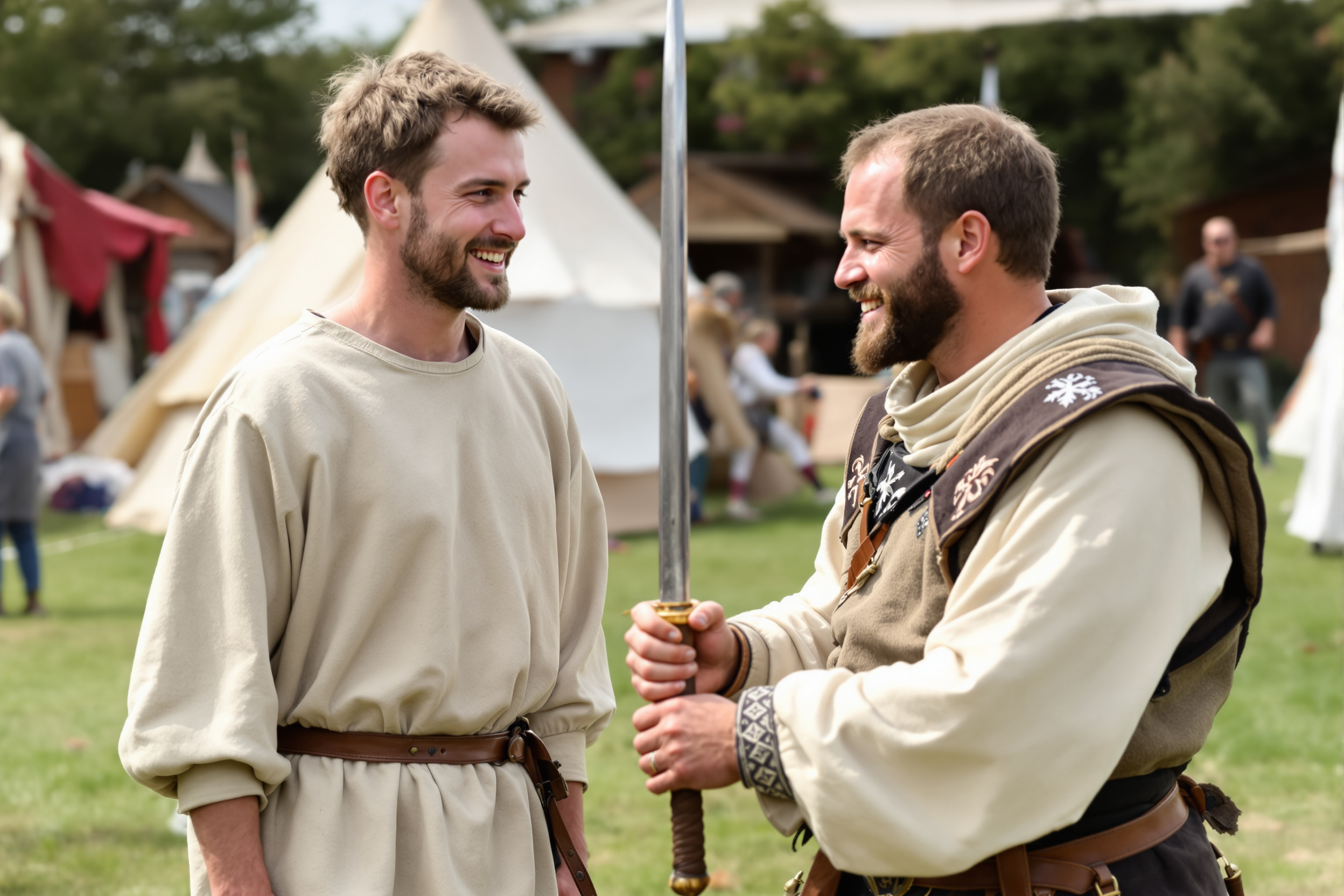
The usual expectation for attending an event is simple: make an attempt at pre-1600 clothing. Reenactors call this clothing "garb," and the standard is an honest effort, not perfection. Almost everyone has items around the house that, combined thoughtfully — a plain tunic, a simple dress, a belt, soft shoes — will pass as a good first attempt. Many groups even keep a stock of loaner clothing (traditionally managed by a hospitality officer sometimes called the "Gold Key") so a newcomer can borrow an outfit for a first event. Nobody expects a beginner to arrive in a tailored court gown.
The Heart of It All: Courtesy
If there is one thing that defines the culture of reenactment, it is courtesy. As one long-time participant put it, courtesy is a simple thing — addressing one another as "milord" or "milady," a small bow, a kind word, holding a door. This gentle formality is part of the fun, and it is also what makes events feel safe and welcoming for everyone. If you would like to get it right, our guide to forms of address explains how to greet royalty, nobility, and honored guests.
Finding Your Craft
Once you are hooked, the question becomes what do I want to learn? The possibilities are enormous:
- Armored and rapier combat — supervised, rules-based martial sport.
- Archery and thrown weapons — target shooting in period style.
- The Arts & Sciences — sewing, cooking, brewing, metalwork, woodwork, calligraphy, illumination, weaving, and much more. Start with our Arts & Sciences overview.
- Music, dance, and theater — performing the entertainments of the period.
- Heraldry and scribal arts — designing coats of arms and lettering beautiful scrolls. See our introduction to heraldry.
A Note on Cost and Commitment
You can enjoy this hobby on almost any budget. Beginners are encouraged to borrow, improvise, and build up slowly. There is no pressure to spend, compete, or take on responsibilities; many people happily attend for years simply to socialize and learn. For a deeper sense of the ideals that animate the community — loyalty, courtesy, generosity, service — read the qualities of honor.
However you begin, begin gently and follow your curiosity. The rest — the skills, the friends, the small triumphs — tends to take care of itself.