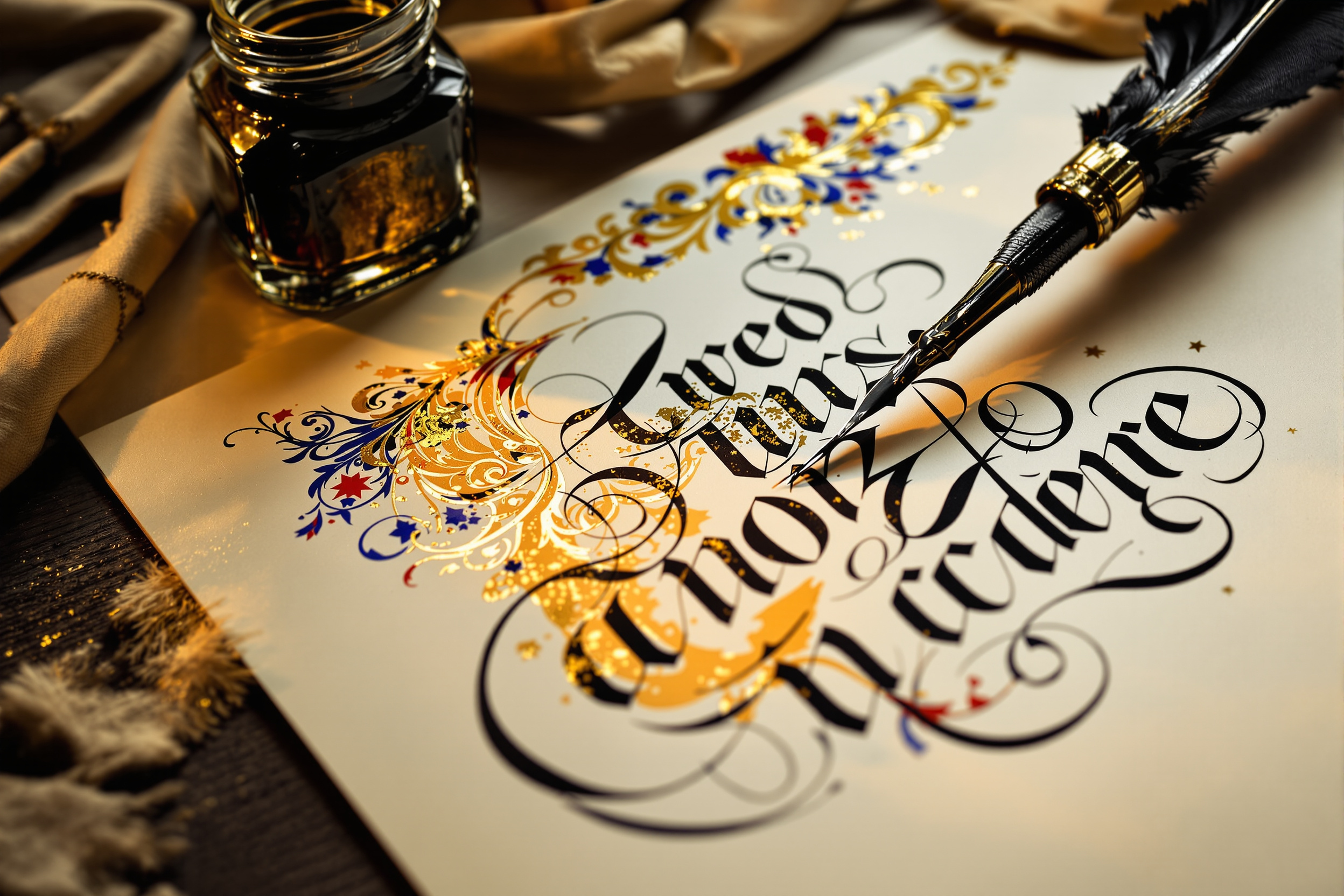
Alphabet Sentences for Calligraphers: Pangrams for Practice
A pangram is a sentence that uses every letter of the alphabet at least once. For anyone learning calligraphy, illumination, or hand-lettering, pangrams are the perfect practice text: a single short sentence puts every letterform, and every awkward join, in front of your pen. This is a collector’s list of alphabet sentences — some famous, some delightfully strange — kept here as a free reference for scribes.
Why Scribes Use Pangrams
When you are drilling a hand — whether a rounded Carolingian minuscule, a spiky Gothic textura, or a flowing italic — you need to practice all twenty-six letters, not just the easy ones. A pangram guarantees full coverage in a compact, memorable line, so you can judge the evenness of your spacing, the consistency of your slant, and the rhythm of the whole alphabet in one pass. Working a fresh pangram each session keeps practice from going stale.
The List
Each of the following sentences contains all 26 letters:
- Cwm fjord-bank glyphs vext quiz.
- Sphinx of black quartz, judge my vow.
- Pack my box with five dozen liquor jugs.
- The quick brown fox jumps over the lazy dog.
- Zany Eskimo craves fixed job with quilting party.
- The wizard quickly jumped over five green boxes.
- Five quart cans of wax kept my jeep glazed bright.
- Joggers are vexed by flocks of quizzical water nymphs.
- Six of the women quietly gave back prizes to the judge.
- My grandfather picks up quartz and valuable onyx jewels.
- Jacqueline was vexed by the folks who got the prize money.
- Just keep examining every low bid quoted for zinc etchings.
- Fred specialized in the job of making very quaint wax trays.
- Brown jars prevented the mixture from freezing too quickly.
- Zippy hovercrafts jockey along beside quays except midweek.
- Pairs of lazy, knowing oxen came by, quietly evading the jam.
- Kegs of exquisite fuzzy plants will rejuvenate blighted compost.
- Back in my quaint garden, jaunty zinnias vie with flaunting phlox.
- Voyez le brick geant que j’examine pres du wharf. (a French pangram)
How to Practice
- Warm up with a few strokes and drills before lettering words.
- Rule your lines. Consistent guidelines — baseline, waistline, ascender and descender lines — are the foundation of a good hand.
- Write slowly. Calligraphy rewards deliberate, even strokes far more than speed.
- Compare and repeat. Letter the same pangram twice and set the two side by side; your eye will find what to fix.
Beyond the Pangram
Once a hand feels steady, scribes usually graduate from single sentences to longer set pieces — a favorite poem, a psalm, or a passage of period prose — which test not just individual letters but spacing across whole lines and the discipline of a consistent page. Two other drills pair well with pangrams. First, the plain alphabet in order, majuscule and minuscule, which isolates each letterform for close attention. Second, letter pairs and troublesome joins — the sequences where your particular hand tends to wobble — practiced in short repeating strings. A pangram a day for warm-up, an alphabet for precision, and a passage for endurance make a well-rounded practice.
It is also worth knowing why these odd sentences exist at all. A good pangram is a small feat of wordplay: fitting all twenty-six letters into as few, or as elegant, a set of words as possible. ‘Cwm fjord-bank glyphs vext quiz’ manages it in just twenty-six letters — one of each — while ‘The quick brown fox jumps over the lazy dog’ earned its fame by being both complete and perfectly natural to read. For a scribe, that naturalness is a gift: an easy sentence lets you concentrate on the pen, not on deciphering the words.
The scribal arts — calligraphy and illumination — are among the most beloved of the Arts & Sciences, and beautifully lettered scrolls are a highlight of any gathering. If you are just beginning, the manuscript collections at the Getty and other museums offer endless inspiration in the hands of the medieval masters. Ink your pen, rule your lines, and let a fox jump over a lazy dog until the letters come easily.