The Regional Community: Local Groups of the Inland Northwest
Medieval and Renaissance reenactment in the Inland Northwest is not one club but a scattering of local groups, each meeting close to home and each with its own long-standing name and character. This page offers a descriptive overview of that regional community — where its groups are found and what they do — for readers who want to understand the landscape. It is not a directory of contacts, and it does not speak for any group.
A Region of Many Groups
The Inland Northwest is big country, and its reenactment community is spread across it. Local groups have historically gathered in and around:
- Spokane and its suburbs — the largest hub of activity in the region.
- The Tri-Cities (Kennewick, Pasco, and Richland) in south-central Washington.
- Yakima and the central Washington valley.
- Wenatchee and the north-central river country.
- Coeur d’Alene and the Idaho Panhandle lakes.
- Moscow and Pullman, the university towns of the Palouse.
- Sandpoint and the far north of Idaho.
- Walla Walla and the wheat country of the southeast.
The groups in these places carry traditional names — Wealdsmere, Vulkanfeldt, Silverhart, Lyonsmarche, Pendale, Grimwith, Ambergard, Akornebir, and others — that the members themselves have used for decades. We mention them here only descriptively, as the familiar labels of the region’s living-history community; each group governs itself and maintains its own current information elsewhere.
What a Local Group Does
The rhythm of a local group is wonderfully consistent from town to town. Most hold a regular meeting — a business gathering to plan events and share news — and one or more weekly practices for armored combat, rapier, archery, dance, or a particular craft. Many run arts-and-sciences nights where members teach one another to sew, cook, letter, or work metal. And each looks forward to the events it hosts or travels to across the year; you can read about the shape of that calendar on our gatherings and events page.
Types of Local Group
In the traditional structure, local groups come in a few sizes, borrowed from medieval usage:
- A barony is a large, well-established group, often with ceremonial local figureheads.
- A shire is an independent group of moderate size.
- A canton is a smaller group nested within a barony’s area.
- A college is a group centered on a university or campus community.
These distinctions mostly concern size and self-governance; to a newcomer they make little practical difference. What matters is that somewhere near you, people are meeting to do this.
Finding an Active Group
Because this is an independent educational resource and not an organizational directory, we do not publish group contacts, which change over time. If you would like to join a group near you, the national and regional bodies of the hobby maintain up-to-date directories; the Society for Creative Anachronism is the usual starting point for locating a local branch. Our newcomer’s guide explains what to expect once you find one and walk through the door.
The SCA kingdom directory offers a Kingdom Lookup Tool for finding the nearest local group, and its local listings describe the areas they cover. Begin with your location, then read the coverage statement instead of choosing by a group’s name alone. The directory describes twenty kingdoms and hundreds of local groups, including cantons, shires, and baronies, so it helps to separate the broad kingdom search from the local search. Keep a short note of the listing you consulted and the area it names. If you are comparing possibilities, ask a practical question first: which listing actually includes the place where you live? That gives the rest of your reading a clear starting point.
A Culture of Hospitality
For all their differences in size and location, the region’s groups share a striking family resemblance in spirit. Newcomers are welcomed rather than tested; loaner clothing and gear are offered freely; and the newest member is invited to sit at the same table, and hold the same cup, as the most accomplished. That hospitality is not incidental — it is the deliberate result of a shared ethic of courtesy and service that the community holds up as its ideal. It is also, quite simply, why people stay: the crafts and the combat draw them in, but the friendships keep them.
A Word on Geography
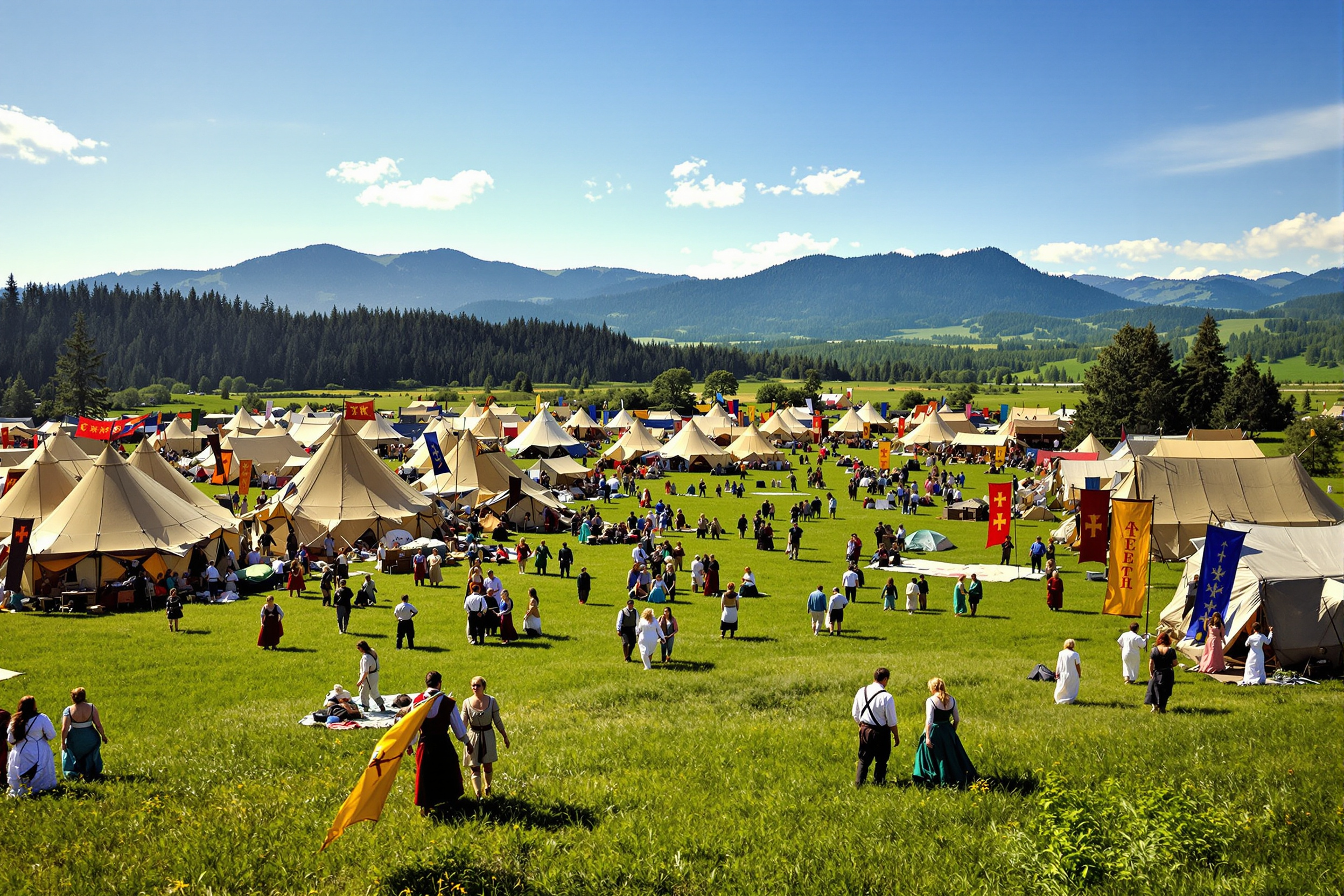
The Inland Northwest is defined as much by distance as by anything else. Groups here may sit two or three hours’ drive apart, so travel is woven into the culture: a gathering in Spokane may draw carloads from Coeur d’Alene, the Palouse, and beyond, and the big summer events become reunions for a community scattered across three states. That willingness to cross the miles is part of what binds the region together into something larger than any single town’s club.
That habit of driving scales up with the seasons. Summer draws the region’s carloads to the big camping events; midwinter, when the list fields freeze and practice moves indoors, has long sent a smaller and more determined contingent much farther afield — historically as far as the February wars of the desert Southwest. A group’s willingness to caravan, and its stock of shared camping gear, says as much about its character as the crafts it favors. If you are weighing a first long trip, our account of the long drive south to a winter war describes what those journeys involved and what a week under canvas asks of a traveler.
This site is not affiliated with, and does not represent, any of the groups named above. Names are used descriptively only.