Introduction to Heraldry
Heraldry is the art and system of designing, describing, and displaying coats of arms — the colorful hereditary emblems that identified individuals, families, and institutions across the medieval and Renaissance world. In living history it adds pageantry and color to every gathering: each participant may design a personal device, and each group its own arms. This primer introduces the vocabulary and the core rules so that a beginner can read, and eventually design, a coat of arms.
What Is a Coat of Arms?
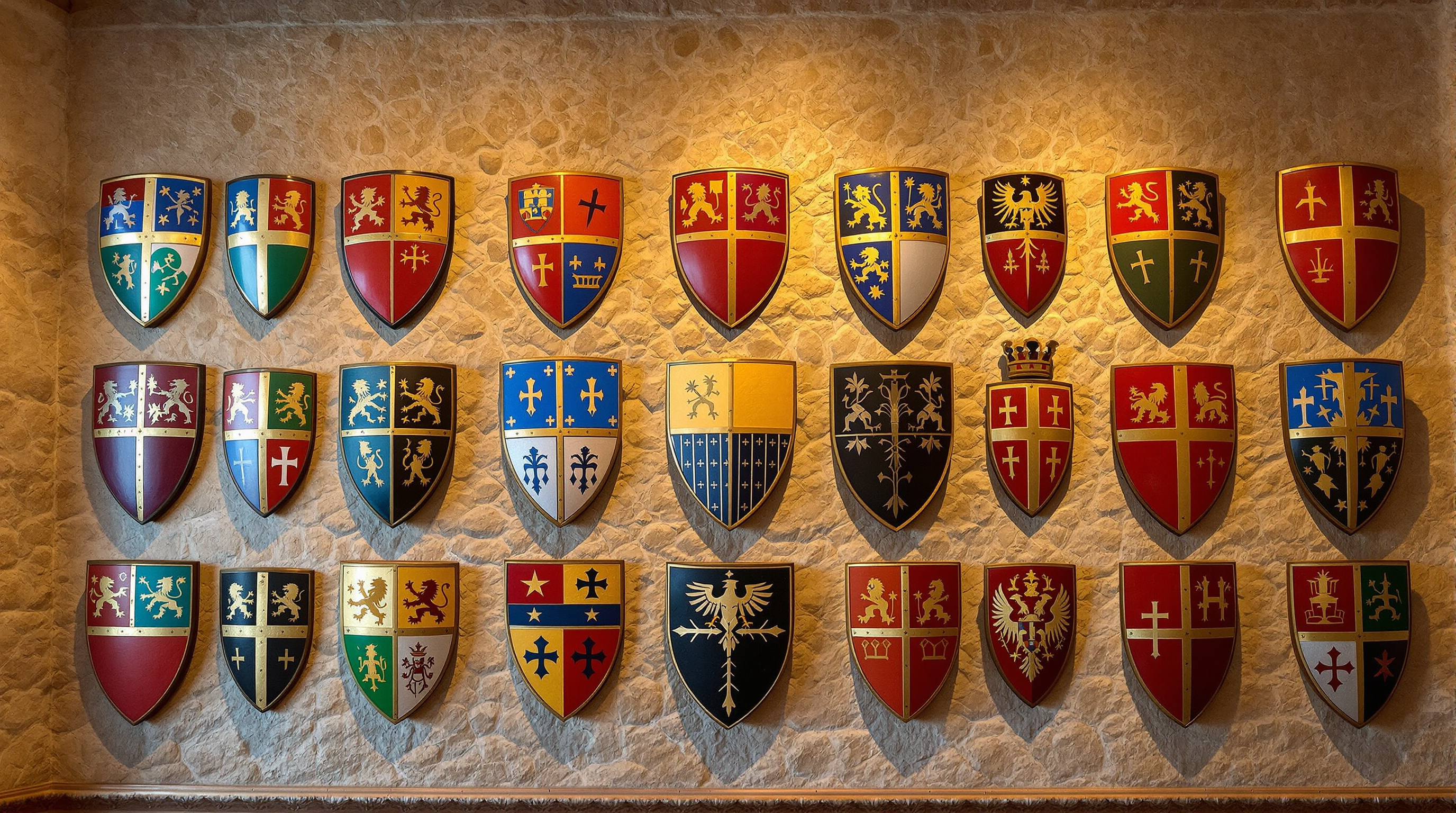
A coat of arms — more precisely a device — is a picture built from two ingredients: the field (the background, and how it is divided) and the charges (the objects placed upon it: animals, plants, tools, geometric shapes, and countless others). A good device is distinctive, so that it can be recognized at a distance on a banner or shield, and it follows a small set of rules that keep it legible.
The Rule of Tincture
The single most important rule of heraldry is the Rule of Tincture: keep contrast between the layers. The colors of heraldry are divided into ‘colors’ and ‘metals,’ and the rule is simply that a metal must be placed on a color, and a color on a metal — never color on color, nor metal on metal. This is what makes a coat of arms readable from far off, in dim light, or in motion.
The Colors (tinctures)
- Sable — black
- Azure — blue
- Gules — red
- Vert — green
- Purpure — purple
The Metals
- Argent — silver, usually shown as white
- Or — gold, usually shown as yellow
The Furs
A third category, the furs, may stand in for either a color or a metal. The most common are:
- Ermine — black tails on white
- Counter-Ermine — white tails on black
- Erminois — black tails on gold
- Pean — gold tails on black
Dividing the Field
The field can be left plain or divided in many ways — per pale (a vertical split), per fess (horizontal), per bend (diagonal), quarterly (into four), and more. When a field is party (divided) between a color and a metal, charges may cross the division freely, because the contrast rule is already satisfied on each side. Learning the common divisions is the first step to reading real arms.
Blazon: The Language of Arms
A blazon is the precise verbal description of a coat of arms. Heraldry developed its own compact language — drawn largely from Norman French — so that a device could be recorded in words and reproduced exactly by any artist. ‘Azure, a bend Or,’ for example, means a blue shield crossed by a gold diagonal band. Once you know the tinctures and the ordinaries, surprisingly complex arms become readable at a glance.
Learning by Flash Card
One time-tested way to learn heraldry is with flash cards: a picture on one side, the blazon on the other. Our companion page on the arms of the Known World offers a printable flash-card exercise for practicing recognition and blazon. Coloring, cutting out, and quizzing yourself on real arms fixes the vocabulary far faster than reading alone.
Common Charges and Ordinaries
Between the plain field and a fully realized coat of arms sits a middle layer worth knowing. The ordinaries are the simple, bold geometric bands that heralds reach for first: the fess (a horizontal band across the middle), the pale (a vertical band), the bend (a diagonal), the chevron (an inverted V), the chief (a broad band across the top), and the cross and saltire (the upright and diagonal crosses). Because they are large and geometric, ordinaries read clearly at a distance, which is exactly what a battlefield emblem needs.
Charges are everything else placed on the field — and medieval imaginations ranged widely. Lions and eagles are the great heraldic beasts; you will also meet stags, boars, wolves, and the occasional griffin or dragon. Beyond animals come stars (mullets), crescents, roses, fleurs-de-lis, keys, swords, and towers. The position of a charge is described precisely too: a lion standing upright on one hind leg is rampant, one walking with a raised forepaw is passant. Learning a dozen ordinaries and a handful of common charges lets you read the great majority of real coats of arms.
Going Further
Heraldry is a deep and rewarding study that connects to genealogy, art, and history. For authoritative background, see the College of Arms, the official heraldic authority of England, and the broad overview of heraldry for its worldwide history. When you are ready to design your own device, start simple, honor the Rule of Tincture, and aim for something you could recognize on a banner across a field.