About the Inland Northwest Living-History Community
The Inland Region takes its name from the Inland Northwest: the high, dry country east of the Cascade crest, where the Columbia Plateau rolls up against the mountains of northern Idaho and western Montana. Spokane sits at its heart, and around it a scattering of towns — the Tri-Cities, Yakima, Wenatchee, Moscow, Pullman, Coeur d'Alene, Sandpoint, Walla Walla, and Omak — have each grown their own circle of medieval and Renaissance reenactors. This page explains what that community does and what this website is (and is not).
What Living History Is
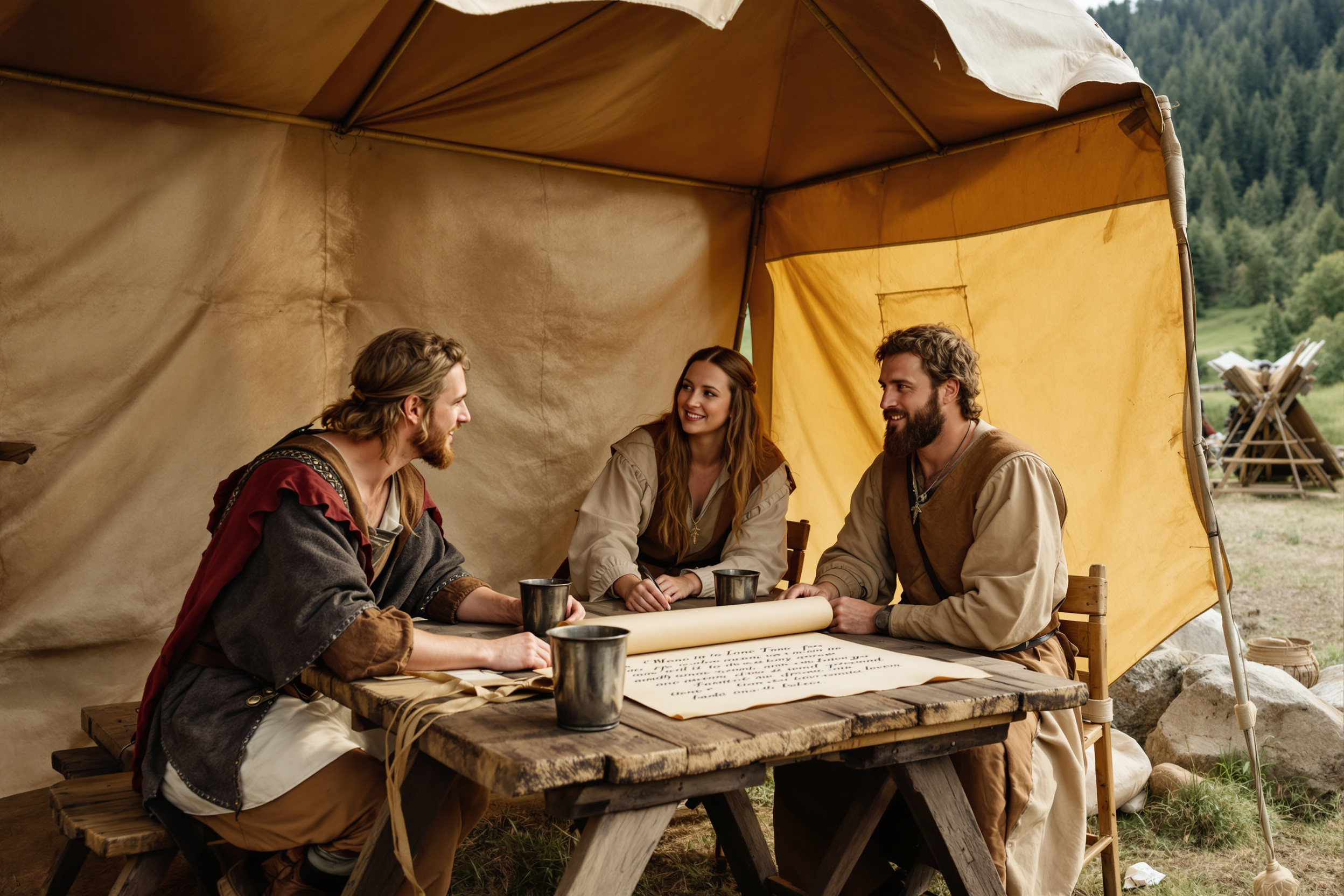
Living history is the practice of studying a past era and then bringing it to life through hands-on recreation. In the medieval and Renaissance tradition that means research first — reading, examining museum pieces, comparing sources — and then making: sewing clothing from period patterns, cooking from surviving recipes, forging and fitting armor, practicing calligraphy and illumination, learning the dances, songs, and games of the age, and taking to the field in armored combat or rapier fencing. Participants often develop a persona, an imagined person who could have lived somewhere in the world between roughly 600 and 1600 C.E., and use it as a lens for their research.
It is equal parts scholarship, craft, and sport, wrapped in an ethic of courtesy. The reward is not only knowledge but a community that spans generations and skills, where a master metalworker and a first-week newcomer sit at the same feast table.
How the Community Is Organized
Across North America, medieval recreation has long been organized through the Society for Creative Anachronism (SCA), an international non-profit educational organization founded in 1966. The SCA divides its map into large regional "kingdoms," which are further subdivided into principalities, regions, and small local groups that meet close to home. The Inland Northwest has historically sat within the northwestern kingdom that covers Washington, Oregon, northern Idaho, and parts of Canada, as a cluster of these local groups.
The SCA describes its community as inclusive, with more than 30,000 members in twenty kingdoms worldwide, pursuing research and re-creation of pre-seventeenth-century skills, arts, combat, and culture. Its kingdom directory places Washington, Oregon, and the northern tip of Idaho in An Tir, alongside most of British Columbia and Yukon. Montana and southern Idaho appear under Artemisia, together with Utah and western Wyoming. For a newcomer near a boundary, start with the directory rather than assuming that a familiar regional label identifies the right kingdom. Read the geographic coverage first, then look for a local group serving your area; the kingdom name is a useful signpost rather than a description of your interests.
You will see the traditional names of those local groups used descriptively on our community page. We use them only as the labels the groups themselves adopted — the way one might refer to a local club by its long-standing name — never to speak for them.
What This Website Is
This is an independent educational resource. It gathers the reference material — glossaries, primers, and how-to guides on castles, heraldry, courtesy, and historical crafts — that the reenactment community here produced and found useful, and presents it for anyone who wants to learn. That material is, at bottom, general medieval history, and it belongs to everyone.
This site is not affiliated with, endorsed by, or an official publication of the Society for Creative Anachronism, its kingdoms, or any local group, and it does not speak for or set policy for any organization. Organization names are used nominatively for context only. We publish no member rosters, officer contacts, or private information. If you are looking for a specific active group to join, the national and kingdom organizations maintain their own current directories.
A Long Tradition in the Region
Organized medieval recreation has been part of life in the Inland Northwest for decades. What often begins as a single campus club or a handful of friends meeting to practice fencing tends to grow, over the years, into a settled local group with its own traditions, its own annual events, and its own generations — parents who joined as students now bringing their children to the same tournaments. That continuity is quietly remarkable in a hobby with no paid staff and no storefront; it runs entirely on the enthusiasm of volunteers who love the work. The volunteers also wrote reference material to make the next newcomer’s path a little easier.
Why Preserve This Material
Good reference writing is timeless. A clear explanation of what a barbican is, or how to address a countess, or why a metal must never be placed on another metal in heraldry, is just as useful today as it was when it was first typed up for a class of newcomers. By keeping these pages available we hope to serve the students, teachers, writers, gamers, and curious readers who arrive here every day with a single honest question — and to send them away knowing the answer.