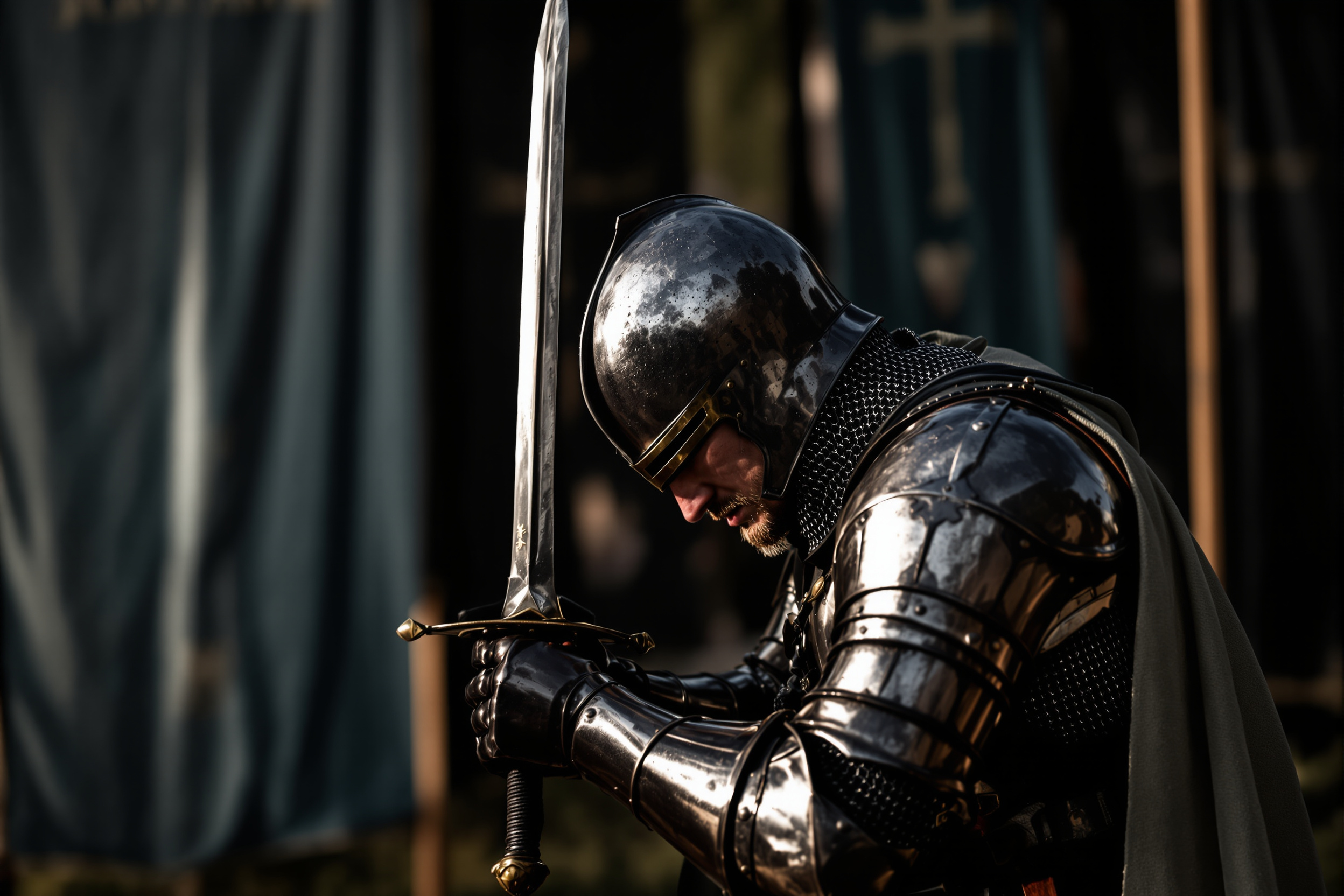
The Qualities of Honor: Chivalry, Courtesy, and Service
Whether or not one ever seeks recognition or rank, striving toward the ideals sometimes called the peer-like qualities is a worthy endeavor. These are the virtues that the medieval world attached to knighthood and mastery, and that the living-history community holds up as a model of conduct. They will serve you well at any gathering — and, quietly, they tend to carry over into ordinary life. This essay lays them out as a kind of compass rather than a checklist.
Loyalty
Loyalty begins with keeping faith: honoring one’s promises, respecting the customs and rules of the community, and showing respect to those who hold responsibility within it. It also means loyalty to the shared ideal itself — supporting the spirit of the endeavor by being as authentic and wholehearted in participation as one’s means allow.
Courtesy
Courtesy is truthfulness and generosity together. The honorable person does not lie or break their word, and does not carry gossip. On the field or at a game they give an opponent the benefit of the doubt. They share knowledge freely, teach willingly, and practice hospitality to the fullest of their means. Courtesy is the visible face of respect, and it is astonishingly powerful precisely because it is so simple.
Restraint
Restraint is self-command. It means speaking softly and politely, keeping one’s temper, and remaining calm when others do not. True strength, the old ideal holds, is shown not in dominating others but in mastering oneself. The person of restraint is a steadying presence in any company.
Gallantry
Gallantry remembers that one’s conduct reflects on more than oneself. The gallant person acts with an awareness that their behavior honors — or dishonors — those they represent and those they hold dear, and so they are careful to do nothing that would tarnish that trust. Gallantry treats others with grace as a matter of course.
Courtliness
Courtliness is the cultivation of the graces that make one worthy of a civilized court. It shows in good manners and correct forms of address, and in a broad, generous curiosity about the culture of the period. The ideal encourages some acquaintance with, and at least modest skill in, one of the courtly arts:
- Dance — at minimum, to recognize the basic dances of a court and to perform one couple dance and one circle dance.
- Music — to identify the common instruments of the period.
- Literature — to be familiar with the stories, poetry, and drama of the age.
- Games — to know, for instance, the pieces of chess and their moves.
- Heraldry — to blazon one’s own arms and recognize common heraldic terms. Our introduction to heraldry is a place to begin.
Prowess and Service
Two further qualities complete the picture. Prowess — skill at one’s chosen martial or creative discipline — is admired most when it is joined to chivalry, so that ability never becomes an excuse for arrogance. And service, the willingness to labor for the good of the whole community without seeking reward, is perhaps the quality the tradition honors above all others. Much of what makes any gathering possible is the quiet work of people who simply chose to help.
A Compass, Not a Cage
No one embodies all of these virtues perfectly, and the point is not to keep score. The peer-like qualities are a direction to walk in — loyalty, courtesy, restraint, gallantry, courtliness, prowess, and service — and the walking is the whole of it. They descend directly from the historical ideals of chivalry, and, like those ideals, they are as useful today as they ever were.