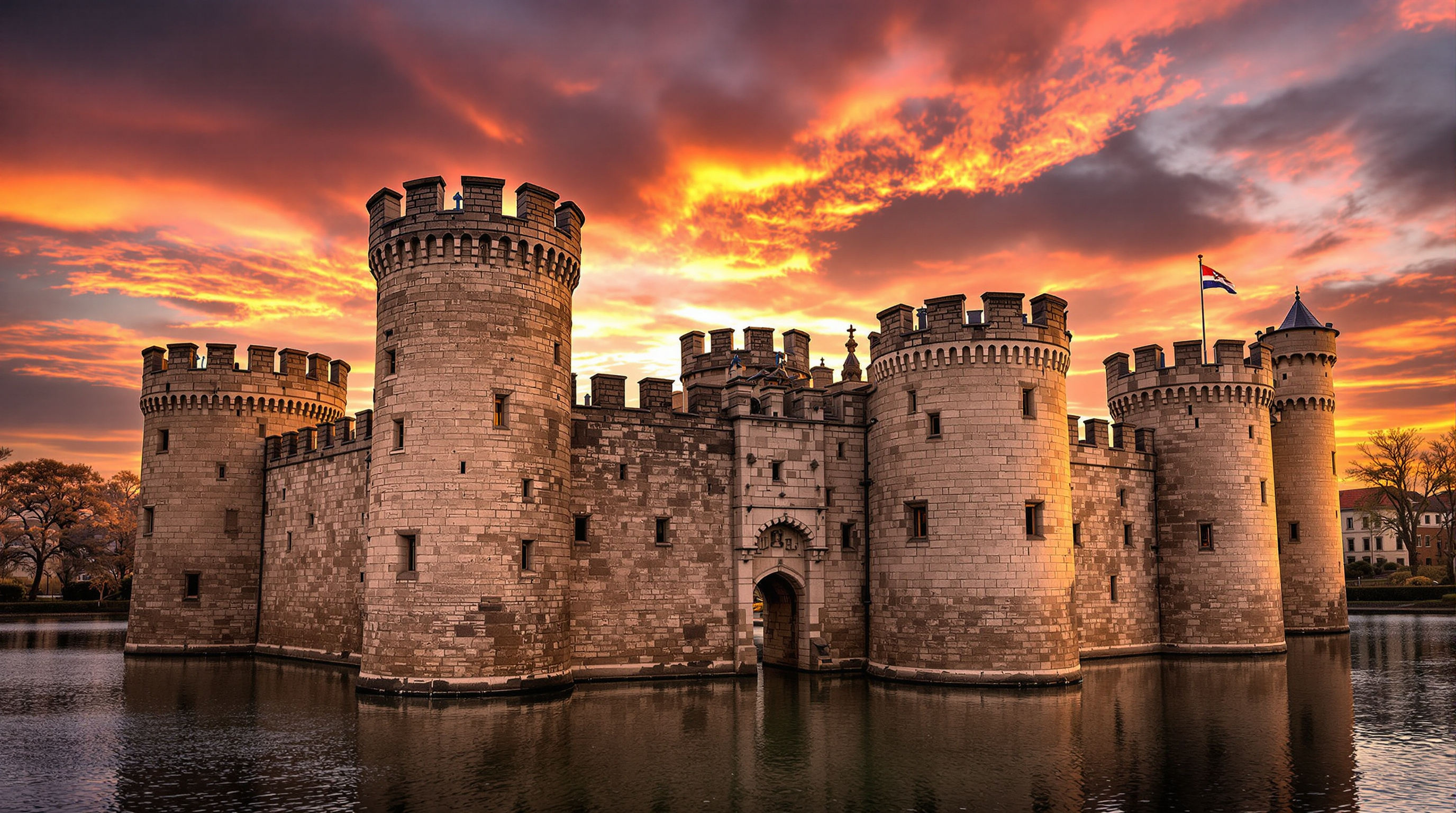
Parts of a Castle: A Glossary of Medieval Castle Architecture
A castle is a machine for defense, and like any machine every part of it has a name and a purpose. This glossary gathers the vocabulary of the medieval castle — the walls, gates, towers, and clever traps by which a garrison held ground against a besieging army. It began life as a study aid for reenactors preparing to explain (or defend) a castle, and it has since served students, writers, gamers, and the simply curious. Each term is defined in plain language, with a note on how it worked.
If you are researching a specific structure, jump to the outer defenses, the gateway, or the walls and towers — or simply read the alphabetical glossary below. For the wider history of these buildings, the resources at Castle Wales and English Heritage are excellent starting points.
The Outer Defenses
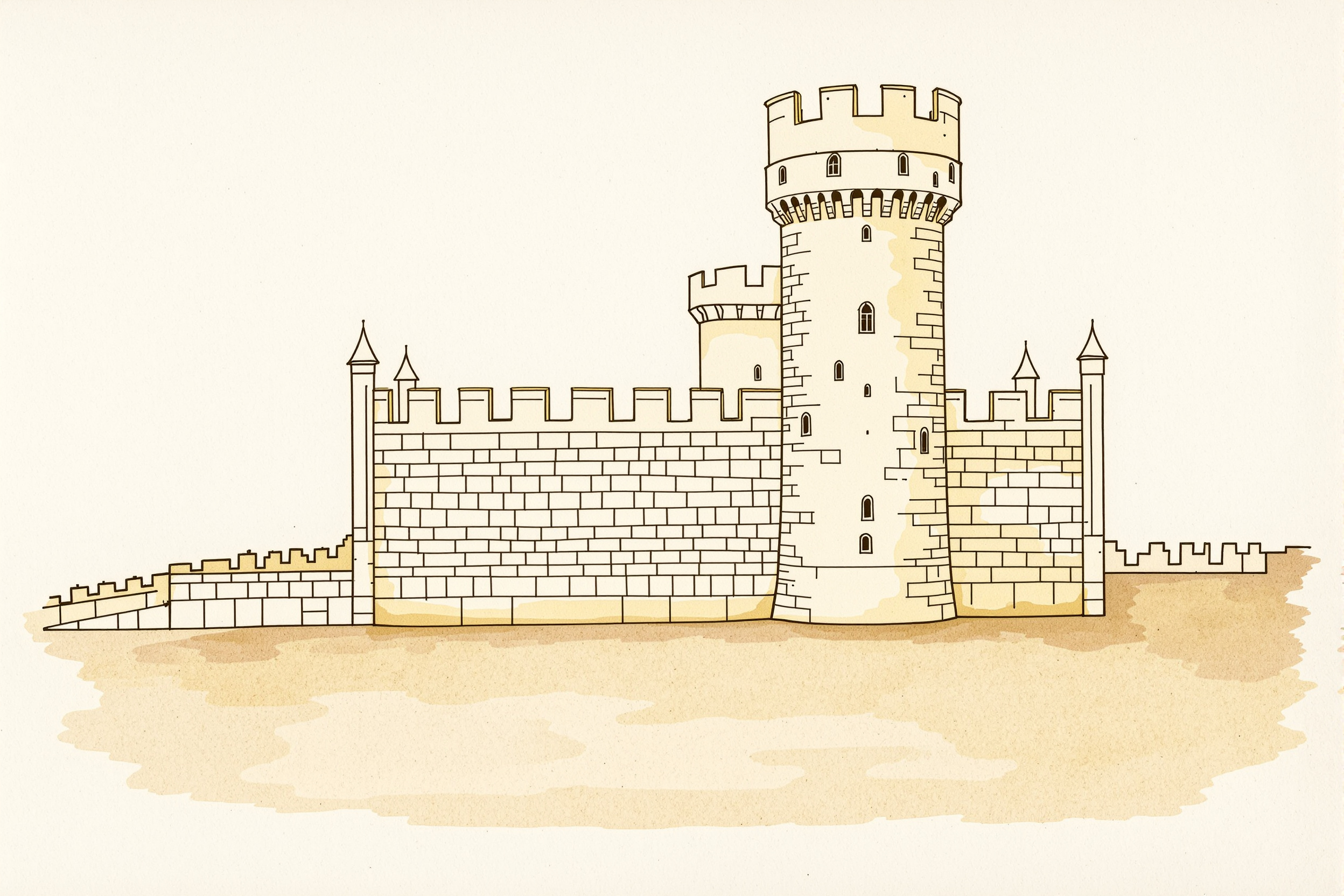
Before an attacker ever reached the wall, a castle tried to stop, slow, and expose them. The moat — a wide ditch, wet or dry — kept siege engines at bay and hindered mining. Beyond or before it might rise a glacis, a smooth outward slope that left attackers no cover, or a palisade of timber stakes crowning an earthwork. The earliest castles were built on a motte, a raised mound, with an enclosed bailey below.
The Gateway
The gate was a castle’s weakest point, so it received its heaviest defenses. Attackers first met the barbican, an outwork that funneled them into the open. Crossing the drawbridge (or a pivoting turning bridge) over the moat, they entered the gatehouse, where a portcullis could drop before and behind them and murder holes in the ceiling rained down stones and fire. A hidden postern elsewhere in the wall let defenders slip out to strike back.
Walls and Towers
The curtain wall encircled the castle, its foot thickened by sloping batters, its top carrying the battlement: a parapet broken into solid merlons and open crenels — the crenelations. From towers spaced along the wall, defenders could shoot along its face. In a siege, timber hoardings (and their permanent stone cousins, machicolations) let them drop stones straight down. At the center stood the keep or donjon, the strongest tower and last refuge of all.
Alphabetical Glossary
- Arrow Loop
- An opening in a fortification wall — usually shaped like a keyhole, a vertical slit, or a cross — through which an archer could shoot while remaining almost entirely protected. Also called an arrow slit or loophole. The cross and keyhole shapes appeared as crossbows and, later, firearms came into use.
- Bailey
- An inner courtyard of a castle, enclosed by the walls. Sometimes called a ward. In the early motte-and-bailey castles, the bailey was the lower enclosed yard that held stables, workshops, and the daily life of the garrison.
- Barbican
- An outer defensive work — walls and small towers built in front of a gatehouse to add protection to the gateway. Some barbicans were simply a tower or a length of wall set at a right angle to the gatehouse, forcing attackers into a killing ground before they could reach the gate itself.
- Basilica
- An alternative term sometimes used for an inner courtyard of a castle, more commonly called the bailey or ward.
- Batters
- A section at the base of a castle wall that is angled or sloped outward. The slope made stones dropped from above bounce outward into the enemy, and it added structural strength to the foot of the wall, making it harder to undermine.
- Battlement
- The fighting position along the top of a castle wall or tower, comprising the crenelated parapet and the wall-walk behind it. The battlement is the classic toothed silhouette most people picture when they imagine a castle.
- Corbel
- A stone bracket projecting from a wall, used to support the weight of a structure above — a floor beam, a parapet, or the timber or stone hoarding that overhung the wall.
- Crenelations
- The alternating pattern of higher and lower sections along the top of a defensive wall (also called embrasures). The pattern gave a defender both cover and openings through which to fight. A royal ‘licence to crenellate’ was once required to fortify a dwelling.
- Crenels
- The lower gaps in the crenelations — the openings a defender shot or looked through. The taller solid sections between them are the merlons.
- Curtain Wall
- The encircling defensive wall of a castle, connecting the towers and other fortifications and enclosing the ward. The curtain wall was the castle’s primary barrier and often carried a wall-walk along its top.
- Donjon
- The great central tower of a castle — the term from which the modern word ‘dungeon’ descends, though the donjon was the strongest and often the most prestigious residence, not merely a prison. It later developed into what English speakers call the keep.
- Drawbridge
- A wooden bridge across a moat or ditch that could be raised or drawn back to make crossing impossible. Raising the bridge sealed the gateway and exposed attackers to fire from above.
- Gatehouse
- A strong fortified structure, usually two towers joined above the main gate, guarding the entrance into the castle. The gatehouse concentrated a castle’s defenses at its most vulnerable point and often contained the portcullis, murder holes, and the drawbridge mechanism.
- Glacis
- A bank or slope of earth or masonry sloping down and away from the fortification. It kept attackers exposed to fire and made it difficult to bring siege equipment or mines close to the wall.
- Hoardings
- Temporary wooden galleries built out from the top of a wall or tower during a siege. Projecting beyond the wall face, they let defenders drop stones and other objects straight down onto attackers at the wall’s foot. The holes that held their supporting beams are the putlog holes.
- Keep
- The strongest and most heavily defended tower of a castle, serving as the last refuge and often the lord’s residence. The English equivalent of the donjon. A keep could stand alone or rise within the walls as the final stronghold if the outer defenses fell.
- Machicolations
- Stone openings in a projecting parapet or floor, built out on corbels, through which defenders could drop stones or pour materials onto attackers directly below. Machicolations were the permanent masonry successor to timber hoardings.
- Merlon
- The solid, upstanding section of a crenelated parapet, between two crenels. The merlons gave the defender cover; the crenels between them gave openings to shoot through.
- Moat
- A deep, wide ditch surrounding a castle, dry or filled with water. A moat kept siege towers and battering rams at a distance and, when flooded, made undermining the walls far more difficult.
- Motte
- A raised earthwork mound on which a tower or keep was built — the ‘motte’ of the early motte-and-bailey castle. The height gave the tower command over the surrounding land and made assault harder.
- Murder Holes
- Openings in the ceiling of a gate passage through which defenders could drop stones, shoot, or pour water on fire (or attackers) below. Combined with the portcullis at each end, the murder holes turned a gateway into a deadly trap.
- Oubliette
- A small, cramped dungeon cell, sometimes reached only through a hatch in the ceiling. The name comes from the French oublier, ‘to forget.’
- Palisade
- A defensive fence or wall of stout timber stakes, driven into the ground and sharpened at the top. Palisades crowned the earthworks of the earliest castles before stone construction became widespread.
- Parapet
- The protective wall along the outer edge of the wall-walk, standing between the defenders and the drop beyond. When crenelated, the parapet forms the familiar battlement.
- Portcullis
- A heavy latticed grille of wood or iron, raised and lowered in vertical grooves within the gatehouse. Dropped quickly, it sealed the gate; a gatehouse often had two, trapping attackers between them beneath the murder holes.
- Postern
- A small, easily defended secondary gate or door, often hidden, that let defenders slip out unseen — to gather water, send messengers, or sally against besiegers. Also called a sally port.
- Putlog Holes
- The square holes left in a wall to receive the horizontal timber beams (putlogs) that supported scaffolding during construction or the projecting hoardings during a siege.
- Tower
- A tall structure rising above the walls, round or square, giving defenders height, a shooting platform, and command of the ground below. Towers along a curtain wall let defenders fire along the wall’s face at anyone attacking it.
- Turning Bridge
- A bridge over a moat that pivoted on a central axle. One end could be swung down or the whole span rotated to break the crossing — a variation on the more familiar drawbridge.
Reading a Castle on the Ground
Vocabulary earns its keep the first time you stand in front of a real castle, or its ruin, and find that you can name what you are looking at. The habit worth building is to read a site in the order an attacker would have met it: begin outside the ditch and work inward. Note where the ground falls away, and whether the water in the ditch was ever live. Find the approach to the gate and see how it is angled — a straight run at a gatehouse is rare, and a bend that forces a rider to expose an unshielded side is a design decision rather than an accident. Look up in the gate passage for the slots of a portcullis and the openings above it. Then follow the wall, counting towers and noting whether they project far enough for defenders to shoot along the face of the curtain between them.
Two cautions keep this exercise honest. Much of what survives is later than it looks, since castles were rebuilt for centuries; and much of what looks defensive is display, a fifteenth-century gatehouse often having more to do with status than with siege. Where a site posts a phased plan, reading it alongside the stones is the quickest way to learn which parts belong to which century.
Learning the Vocabulary
The fastest way to fix these terms in memory is to attach each one to its job in the story of a siege: the moat stops the engines, the barbican funnels the attackers, the portcullis and murder holes trap them at the gate, the battlements shelter the archers, and the keep waits as the final stronghold. Once the words hang on that narrative frame, they are remarkably hard to forget. For deeper reading on how these elements developed across Europe, see the overview of castle architecture at Encyclopaedia Britannica.