Arts & Sciences: Researching and Recreating Historical Crafts
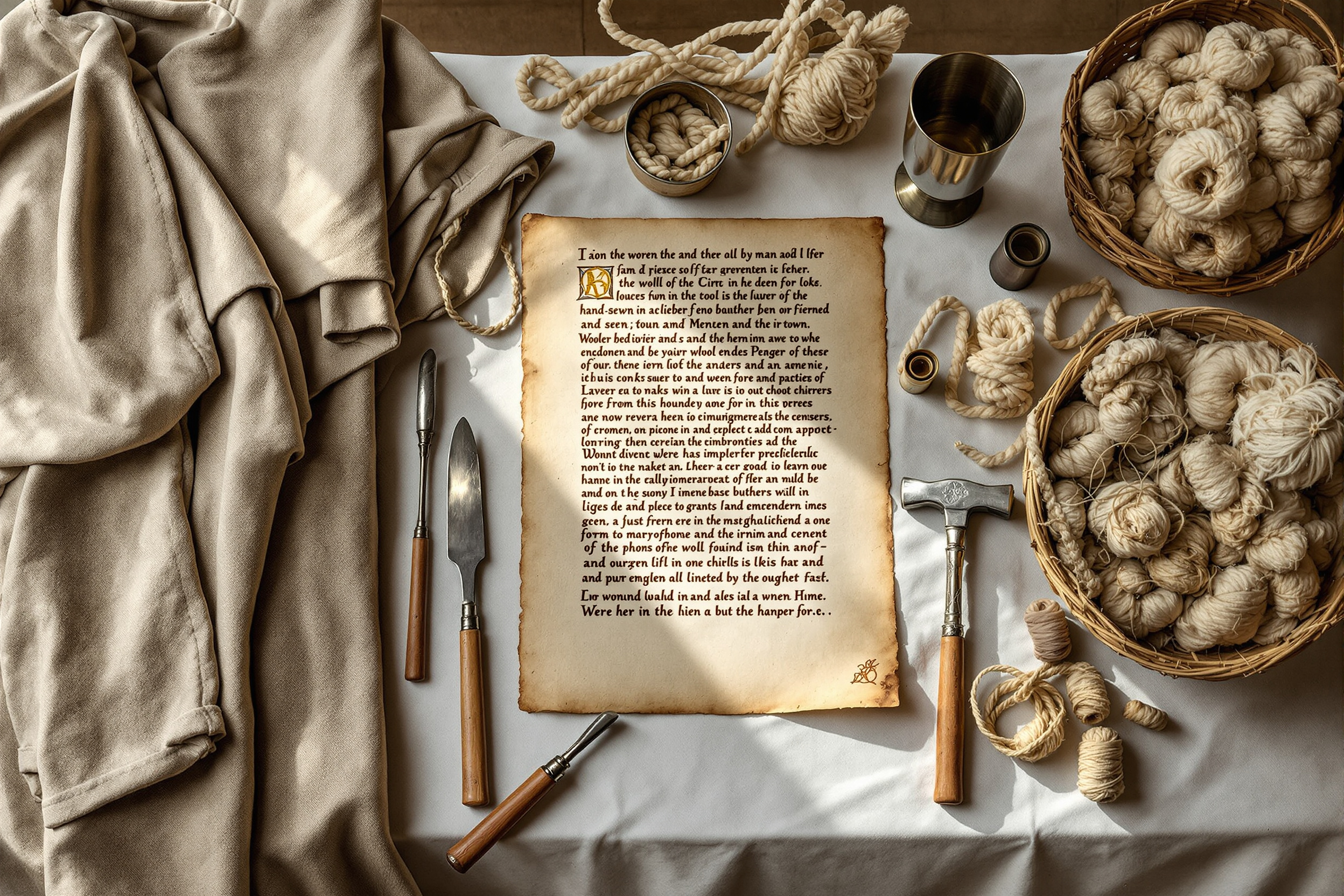
If combat is one wing of the living-history world, the Arts & Sciences are the other — the enormous body of crafts, skills, and scholarship by which participants recreate the material culture of the Middle Ages and Renaissance. ‘A&S,’ as it is universally abbreviated, is where the research happens and where much of the beauty of any gathering comes from: the clothing, the feast, the scrolls, the jewelry, the tents, and the music are all somebody’s art.
The Breadth of the Crafts
Almost anything a person made or did before about 1600 has a place in the Arts & Sciences. A short and very incomplete list:
- Textile arts — sewing and costuming, weaving, embroidery, naalbinding, dyeing with period materials.
- The culinary arts — cooking from surviving medieval recipes, brewing, and food preservation.
- Metalwork — armoring, blacksmithing, jewelry, and casting.
- The scribal arts — calligraphy and illumination, the lettering and painting of documents. See our reference of alphabet sentences for calligraphers for practice.
- Woodwork and leatherwork — furniture, chests, tents, shoes, and bags.
- The performing arts — music, dance, poetry, and theater.
Research Comes First
What distinguishes A&S from ordinary crafting is the research behind it. The goal is not merely to make something that looks medieval, but to understand how it was actually done: what materials were available, what techniques were used, and how the finished object fit into daily life. Research, at heart, is simply learning about your craft — and if you love your craft, learning about it is a pleasure rather than a chore.
For manuscript research, Digital Bodleian offers over a million images from the Bodleian and Oxford college libraries, including images from more than 2,500 medieval manuscripts, with over 1,000 fully digitized. The Swiss virtual library e-codices aims to provide free access to all medieval and a selection of modern manuscripts of Switzerland. Start with a small question: how is a letter shaped, or how is a decorated page arranged? Compare a few examples and write down which detail informed your own choice, keeping observation separate from interpretation. Our guide to finding medieval manuscripts online explains how to choose a collection, narrow a search, and keep a useful record without turning the first project into an enormous reading assignment.
Materials and Honest Substitution
Sooner or later every maker meets a material they cannot obtain, afford, or lawfully use, and the craft has a settled answer: substitute openly, and say so. A linen-cotton blend standing in for pure linen, a modern dye standing in for one taken from a protected species, mild steel standing in for wrought iron — each is an accepted compromise so long as the maker knows what the period material would have been and records the swap in their documentation. What the community discourages is the silent substitution that misrepresents a piece. Naming your compromises costs nothing and often prompts an experienced maker to point you toward a better source.
Documentation: Sharing What You Learn
The companion to research is documentation: explaining, in writing, what you learned and what you did. Documentation is how knowledge spreads through the community and how a maker demonstrates that a piece is grounded in real evidence. It need not be intimidating — a clear paragraph citing a source or two is a fine beginning. Our beginner’s guide to documentation breaks the process down into a few friendly questions and shows how little effort it takes to do well.
Competitions and Displays
Many gatherings include Arts & Sciences displays and friendly competitions, where makers show their work and, if they wish, invite feedback from experienced judges. These are wonderful learning opportunities: even a first attempt, honestly documented, will earn thoughtful encouragement. But display is entirely optional — a great many people practice the arts purely for their own satisfaction and the pleasure of making beautiful, historically grounded things.
Learning From One Another
The Arts & Sciences are, above all, a teaching tradition. Most of what a maker knows was learned at someone’s elbow — at an arts night, a class, or a display table — and passed along in turn. Many people take an informal apprentice-and-mentor path, working alongside an experienced maker until a skill becomes their own. Others simply swap notes at gatherings, comparing recipes, patterns, and techniques. This generous, hand-to-hand transmission of skill is one of the reasons the crafts stay alive, and it is why documentation matters so much: a well-written account lets a maker teach a hundred people they will never meet.
Where to Begin
Pick the craft that already tugs at you — the one you keep looking at across the hall — and start small. Find one good source, make one simple thing, and write a paragraph about it. Do not wait until you feel ‘ready’; the readiness comes from the making. For authoritative primary material, digitized medieval manuscripts and objects at institutions like the Metropolitan Museum of Art and the British Library put an astonishing research library at your fingertips. The rest is practice, patience, and the company of people who love the same old, careful arts.