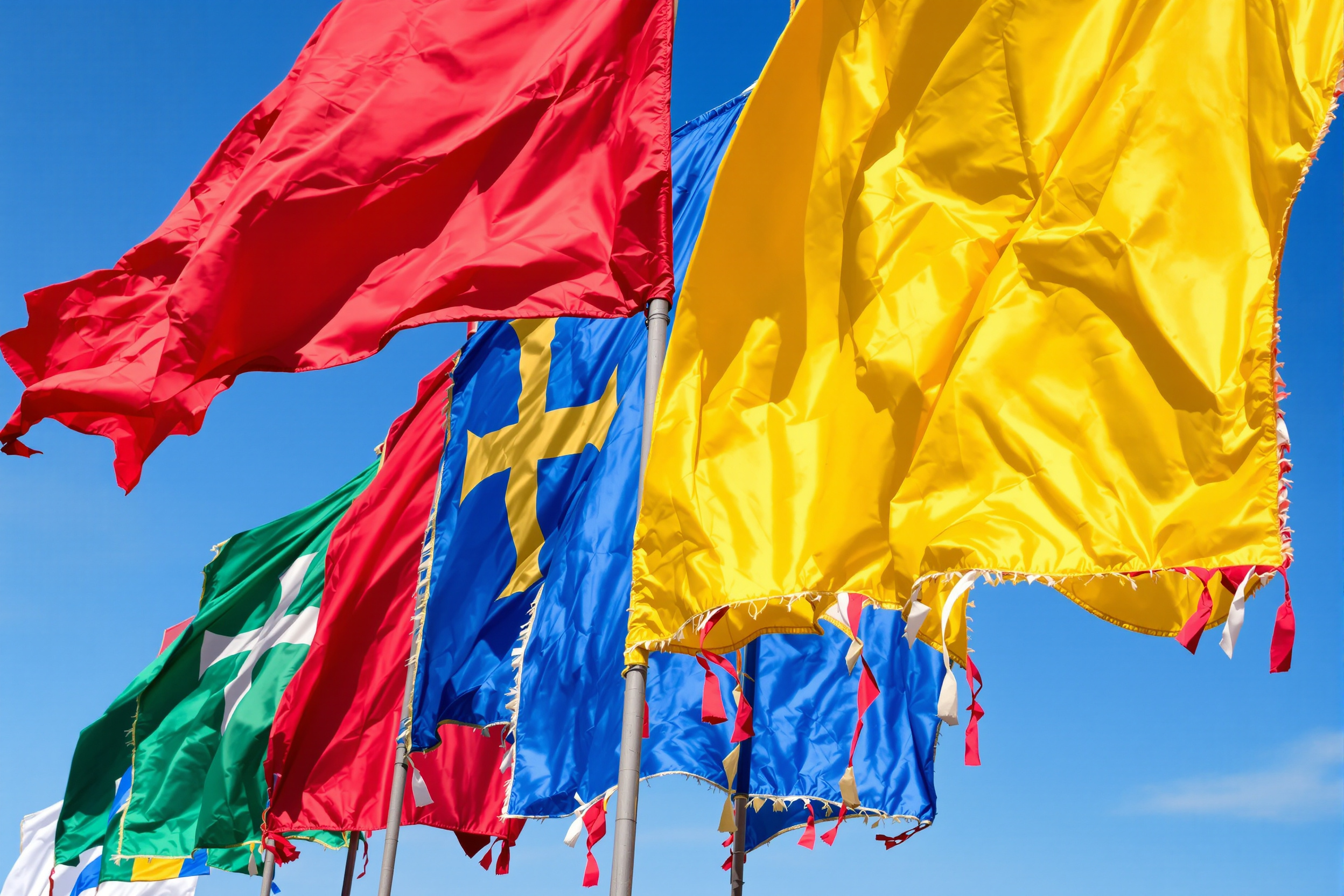
Arms of the Known World: Heraldry of the Reenactment Realms
Medieval-recreation groups on a large scale organize themselves into great regional realms, playfully called kingdoms, and the whole map of them is known affectionately as the Known World (or ‘Knowne World,’ in period spelling). Each realm registers its own coat of arms, and learning to recognize those arms — and to place the realms in their traditional order of precedence — is a classic exercise for students of heraldry. This page explains the idea and offers a flash-card method for learning it.
The Idea of the Known World
Just as the historical medieval world was a mosaic of kingdoms, principalities, duchies, and baronies, the reenactment world mirrors that structure. A kingdom is the largest unit, covering a broad geographic area; within it may sit principalities, regions, and small local groups (variously called baronies, shires, cantons, and colleges) where members actually meet. Over the decades this structure has grown to roughly a score of kingdoms spanning several continents, each with its own heraldry, traditions, and character.
Order of Precedence
Kingdoms are traditionally listed in an order of precedence — broadly, the order in which they were established. A learner’s list of the Known World’s realms, in that customary order, runs: the West, the East, the Middle, Atenveldt, Meridies, Caid, Ansteorra, Atlantia, An Tir, Calontir, Trimaris, the Outlands, Drachenwald, Artemisia, AEthelmearc, Ealdormere, Lochac, Northshield, and Gleann Abhann. The Inland Northwest sits within the northwestern realm on that list. Precedence is a gentle formality, useful mainly for processions and for organizing exactly this kind of study.
The Society’s kingdom directory counts twenty kingdoms. Include Avacal in a complete flash-card set alongside the nineteen names above: its listing covers Alberta, eastern British Columbia, the Northwest Territory, and Saskatchewan. Give it a separate card rather than trying to fit it into another realm’s geographic notes. For each card, keep the kingdom name and the area described in the directory together, while treating the heraldic image and blazon as a separate research task. Check names against the directory before beginning the drawing exercise. This makes the set useful for two distinct questions: which kingdom is being named, and which area does its listing cover?
Where the Whole Map Assembles
The one place a student of heraldry sees the entire Known World at once is a large inter-kingdom war, where each realm camps together beneath its own banner and the arms you have been drilling on flash cards stand twenty feet up on painted canvas. Processions at such gatherings follow the order of precedence closely, so a herald who has learned the list can call the line correctly on sight. This is why the flash-card exercise below repays the effort: it is not an abstract quiz but preparation for a real and rather beautiful moment, when a field of pavilions resolves itself into a map of the realms and you find that you can read it.
A Flash-Card Exercise
Heraldry rewards recognition practice, and the arms of the realms make a perfect training set because each is distinct and follows the Rule of Tincture. A simple, effective method:
- Make cards. Put a line drawing of each realm’s arms on one side of a card.
- Color them. Coloring the arms by hand teaches the tinctures far better than looking at finished images — you have to decide which layer is metal and which is color.
- Add the blazon. Write the verbal blazon on the reverse.
- Quiz yourself. Recognize the arms from the picture; recite the realm from the blazon.
Working through the full set, you will absorb not only the individual arms but the whole vocabulary of heraldry — ordinaries, charges, divisions, and the tinctures — without ever feeling like you are studying.
Designing Within the System
Because every realm, group, and individual registers arms, heraldry in reenactment is a living practice with heralds who check new designs for conflict and correctness, much as historical heralds once did. If you are drawn to it, begin with our introduction to heraldry, learn to blazon a few real arms, and then try designing a simple device of your own. For the historical roots of these systems, the overview of rolls of arms shows how medieval heralds recorded the devices of an entire realm — the very tradition these flash cards echo.
Principalities, Regions, and Branches
Beneath the kingdoms, the same heraldic logic runs all the way down. A principality — a large region on its way to becoming a kingdom, or one that has chosen to remain a coronet-led realm — carries its own arms, as do the baronies, shires, cantons, and colleges where members actually meet. The result is a nested system of heraldry: an individual bears personal arms, their local group bears branch arms, and the whole sits within a kingdom’s arms, each layer distinct and each following the same rules. Learning to read this hierarchy from a banner line at an event is one of the quiet pleasures of heraldry.
The custom of ordering realms and displaying their arms together echoes a genuine medieval practice. Heralds kept rolls of arms — illustrated registers recording the devices of the nobility of a region — both to settle disputes and to teach. A modern flash-card set of realm arms is a small, friendly descendant of those great rolls, and working through one gives you a real feel for how a herald once carried an entire realm’s heraldry in memory.
Note: this page teaches the concept and method of learning realm heraldry; it does not reproduce any specific registered device. To study particular arms, consult the relevant organization’s own heraldic registry.